 +65 6873 0809
 info@chirotherapy.com.sg
Blog
Recurring Lower Back Pain: Why It Keeps Coming Back
Sep
Recurring lower back pain is the rule, not the exception: around 7 in 10 people who recover from an episode have another within 12 months. Pain fading and the problem resolving are two different things. This blog walks you through why it keeps returning, what actually prevents relapse, and where chiropractic adjustment and decompression fits into keeping it away.
Why does lower back pain keep coming back after it feels better?
Lower back pain recurs because pain resolves faster than the strength, mobility, and load tolerance that failed in the first place. You feel better within days, but the lumbar spine’s capacity to handle load takes weeks longer to rebuild. Stop your rehabilitation the moment the pain stops, and the same weakness that triggered the episode is still sitting there, waiting for the next heavy lift or long flight.
This gap is the core mechanism behind relapse. An acute flare of mechanical low back pain settles quickly; the median episode lasts about 5 days, and roughly 90% of people feel recovered within six weeks. Capacity does not track that curve. Muscle endurance, hip mobility, and coordinated movement patterns take longer to normalise, which is why the pain-free window is deceptive. In practice, most people I see returning for a third or fourth episode were never reconditioned after the first. They treated pain relief as the finish line. It is the halfway mark.
What is actually driving your recurring back pain?
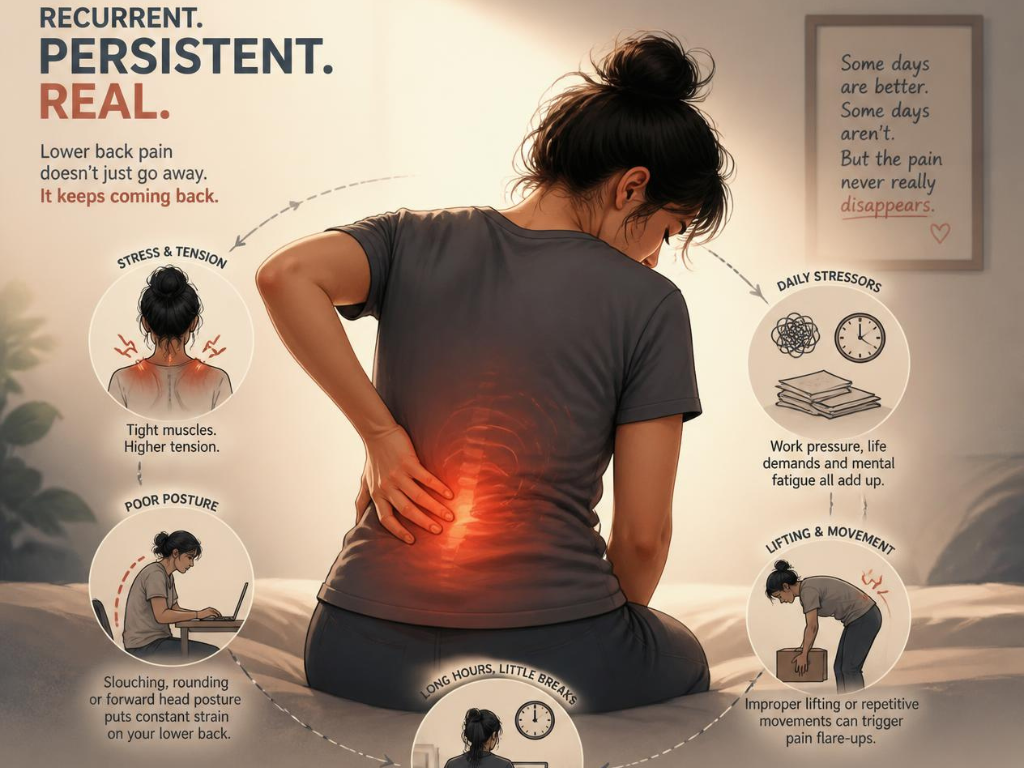
The usual driver is a compensation pattern: a stiff or weak link elsewhere forces the lumbar spine to absorb load it was never meant to carry. Two culprits dominate. A hip mobility deficit, common in people who sit for long hours, shifts rotation and extension demand into the lower back. Thoracic stiffness in the mid-back does the same from above, because a rigid upper spine makes the lumbar segments overwork on every twist and reach.
Deconditioning compounds it. After an episode, people move less, the deep stabilising muscles switch off, and the back becomes less tolerant of ordinary load, not more. The strongest single predictor of another episode is your history: having more than two previous episodes raises recurrence risk sharply, as shown in prospective cohort work on recurrence of low back pain. Prolonged sitting and awkward sustained postures rank alongside it, which is why the pattern shows up so often in office workers dealing with desk posture strain. Where this breaks down is when treatment only chases the sore spot and ignores the stiff hip or rigid thorax feeding it.

How likely is your back pain to return?
Recurrence is common, and the numbers are consistent across studies. Roughly 69% of people who recover from an episode of low back pain experience another within 12 months, and about 40% have a recurrence severe enough to limit activity again. Care-seeking recurrence, where the pain sends you back to a clinician, runs closer to one in three.
Your personal odds are not fixed, though, and that is the useful part. The single biggest risk factor is a history of multiple prior episodes; a hip mobility deficit, weak trunk endurance, and a job that keeps you seated all day push the odds higher. People who rebuild load tolerance after an episode reset those odds meaningfully. The 2018 Lancet Low Back Pain Series was blunt that most care worldwide chases symptoms rather than prevention, and recurrence is exactly where that failure shows. Understanding your own risk profile is the first step in treating lower back pain as a pattern to manage, not a one-off to patch.
Does feeling better mean your back has actually healed?
No. Pain relief and tissue recovery run on different clocks, and mistaking one for the other is the most common reason back pain returns. Pain is a protective signal that switches off early, often once inflammation settles and the muscle stops guarding. The underlying deficit in strength and control lags well behind.
Think of it as a load-tolerance gap. Your back stops hurting at maybe 60% of its previous capacity, so daily life feels fine until you exceed that ceiling: a weekend move, a long-haul flight, a heavy gym session. Then the same episode repeats. The cleaner approach is to keep rehabilitating for weeks after the pain has gone, progressively loading the lumbar spine and hips until capacity exceeds your real-world demands. Clinics that discharge patients the day pain resolves are optimising for the wrong endpoint, and the recurrence data reflects it. Rebuilding capacity, not chasing comfort, is what closes the gap, and it follows the same logic as sensible recovery timelines for any musculoskeletal injury.
How do you stop lower back pain from coming back?
Movement is the intervention with the strongest evidence, specifically graded exercise and regular walking, not rest. A 2024 randomised trial in The Lancet, WalkBack, followed 701 adults who had recently recovered and found that an individualised walking and education program nearly doubled the pain-free period, pushing median time to recurrence to 208 days versus 112 days for the no-treatment group. Professor Mark Hancock, one of the trial’s authors, reported that the walking group had “a longer average period before they had a recurrence.”
Structured exercise performs just as well. A landmark 2016 review in JAMA Internal Medicine, pooling 21 trials and 30,850 participants, found exercise alone delivered a “35 percent risk reduction for an LBP episode,” per lead author Daniel Steffens, and exercise combined with education reached 45%. The same review found back belts, shoe insoles, and education on its own did nothing to prevent recurrence. The practical formula is unglamorous and effective: restore hip and thoracic mobility, build trunk endurance through progressive load, walk most days, and address the sustained postures at your desk, a focus of any decent soft tissue therapy and rehab plan.
When is recurring back pain a sign of something more serious?
Most recurring back pain is mechanical and not dangerous, but two situations change the picture. Pain that persists beyond 12 weeks is classified as chronic, and 5% to 10% of acute episodes cross into that territory, where deconditioning, stress, poor sleep, and fear of movement start driving the pain more than any tissue problem. Chronic does not mean permanent, but it needs a broader plan than another round of passive treatment.
The second situation is red flags. Loss of bladder or bowel control, numbness around the groin or inner thighs, progressive weakness in a leg, unexplained weight loss, or fever with back pain point to problems that a chiropractor screens for and refers on, not treats. These are uncommon, but they override everything else. Worth noting: recurring pain that is steadily worsening with each episode, rather than flaring and settling, also deserves proper assessment rather than self-management. A responsible clinic runs that screen before assuming your recurrence is just another mechanical flare.
Does chiropractic maintenance care keep it from returning?
For a specific group, yes. Maintenance care means pre-planned chiropractic visits scheduled at intervals rather than only when pain strikes, and the evidence supports it for selected patients with recurrent or persistent pain who respond well to an initial course of treatment. The Nordic Maintenance Care trial randomised 328 such patients and found the maintenance care group had 12.8 fewer days with bothersome low back pain over 52 weeks, at the cost of roughly two extra visits across the year.
The honest read is that maintenance care is not for everyone, and it works best as tertiary prevention layered on top of active rehabilitation, not as a replacement for it. At Chirotherapy, that means a recurrence plan built from assessment: chiropractic adjustment and decompression to restore joint movement, rehabilitation to rebuild load tolerance, and scheduled reviews only where a patient’s history and response justify them. The clinic runs this across its Orchard and Bugis branches, with published session fees so the cost of a maintenance schedule is clear upfront. Needling or manipulation that is never paired with progressive loading buys short relief; the durable results come from the combination.
Conclusion
Recurring lower back pain is not bad luck; it is an unfinished recovery. Pain switches off long before capacity returns, and the gap between the two is where the next episode is born. The evidence is clear that movement closes that gap: walking and progressive exercise cut recurrence by a third or more, while maintenance care helps a selected few. Comfort is not the goal. Capacity is.
If your back pain keeps returning, book a recurrence assessment at Chirotherapy’s Orchard or Bugis clinic. You will get a screen for the hip, thoracic, and strength deficits driving your relapses, plus a plan to rebuild capacity so the pain stops coming back. Book your assessment.
Frequently asked questions
Is it normal for lower back pain to come and go?
Yes. Roughly 69% of people have a recurrence within 12 months of recovering, so pain that comes and goes is the typical pattern for mechanical low back pain, not a sign of failure. The concern is a pattern that worsens with each episode. Recurring but stable flares usually reflect an unresolved load-tolerance gap rather than serious damage.
How long should I keep exercising after my back pain goes away?
Keep going for at least 8 to 12 weeks after the pain resolves, then maintain it indefinitely. The 2024 WalkBack trial showed benefits from a six-month program, and the protection fades if you stop. Capacity built through progressive loading is what prevents the next episode, so treat exercise as ongoing maintenance, not a temporary fix.
Can sitting all day cause my back pain to keep returning?
Yes. Prolonged sitting is a documented risk factor for recurrence, partly because it drives hip mobility deficits and deconditions the trunk muscles that protect the lumbar spine. Breaking up sitting every 30 minutes and restoring hip mobility reduces the load your lower back absorbs. Chirotherapy’s corporate spine screenings target exactly this desk-bound pattern.
Should I get an MRI if my back pain keeps coming back?
Usually not. For recurring mechanical low back pain without red flags, an MRI rarely changes the plan and often shows age-related disc changes that exist in pain-free people too. Imaging is warranted when red flags or genuine nerve compression appear. Otherwise, rebuilding strength and mobility is the higher-value response to recurrence.
