 +65 6873 0809
 info@chirotherapy.com.sg
Blog
Back Pain When Breathing: Rib Problem or Red Flag?
Sep
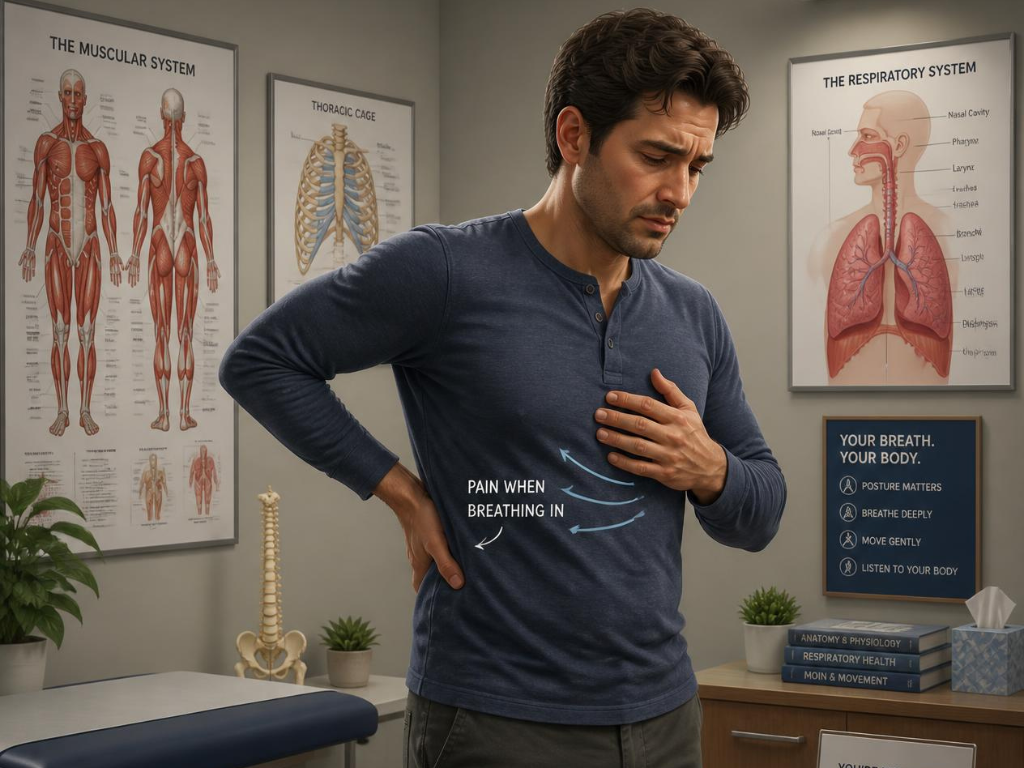
Back pain when breathing sends a jolt of worry through most people, and for good reason: the same symptom covers a stiff rib joint and a blood clot in the lung. Pulmonary embolism turns up in 5% to 21% of pleuritic pain cases at emergency departments. This blog walks you through when it is the ribs, when it is not, and where chiropractic treatment options fit.
Why does your back hurt when you breathe deeply?
Back pain that worsens on a deep breath is usually mechanical, coming from the costovertebral joints where your ribs meet the spine. These small joints move every time your ribcage expands, so a stiff or irritated one produces a sharp catch with each deep breath. Less often, breathing-related pain signals a lung, pleural, or heart problem, which is why screening for red flags comes first.
The anatomy explains the pattern. Each rib connects to the thoracic spine through two synovial joints, the costovertebral and costotransverse joints, which pivot slightly as you inhale. When one of these joints restricts, the rib cannot move cleanly, and the compressed capsule fires a sharp, localised pain on inspiration, coughing, or a twist. The pain is typically one-sided and level-specific, sitting a few centimetres from the spine. Rib mobility even varies by level, with the upper thoracic ribs allowing roughly 4 degrees of movement and the lower ribs closer to 12. The honest position for any clinician is to hold two possibilities in mind at once: the common mechanical cause, and the uncommon serious one that has to be excluded before anything else.

When is back pain that worsens on breathing a rib joint problem?
It is a rib joint problem when the pain is sharp, one-sided, reproducible by movement or touch, and unaccompanied by any systemic symptoms. Costovertebral joint dysfunction produces pain that worsens with thoracic rotation, deep breathing, coughing, or sneezing, with local tenderness over the rib angle. The pain is position-sensitive and movement-provoked, and it stays put rather than spreading with breathlessness or spreading into a heart-attack pattern.
Muscle and nerve sources sit alongside the joint. An intercostal muscle strain from a heavy cough, a rowing session, or an awkward sleep produces a similar catch on breathing, and the pain refers along the rib in a non-dermatomal band. Poor desk posture is a frequent driver, because a rounded thoracic spine loads the rib joints unevenly all day, the same mechanism behind stubborn desk posture strain in office workers. The defining feature of all these mechanical sources is reproducibility. Press on the joint, rotate the trunk, or load the rib, and the pain reappears on demand. That reproducibility is the single most useful clue that the problem is the ribs, not the organs beneath them.
When is back pain when breathing a red flag?
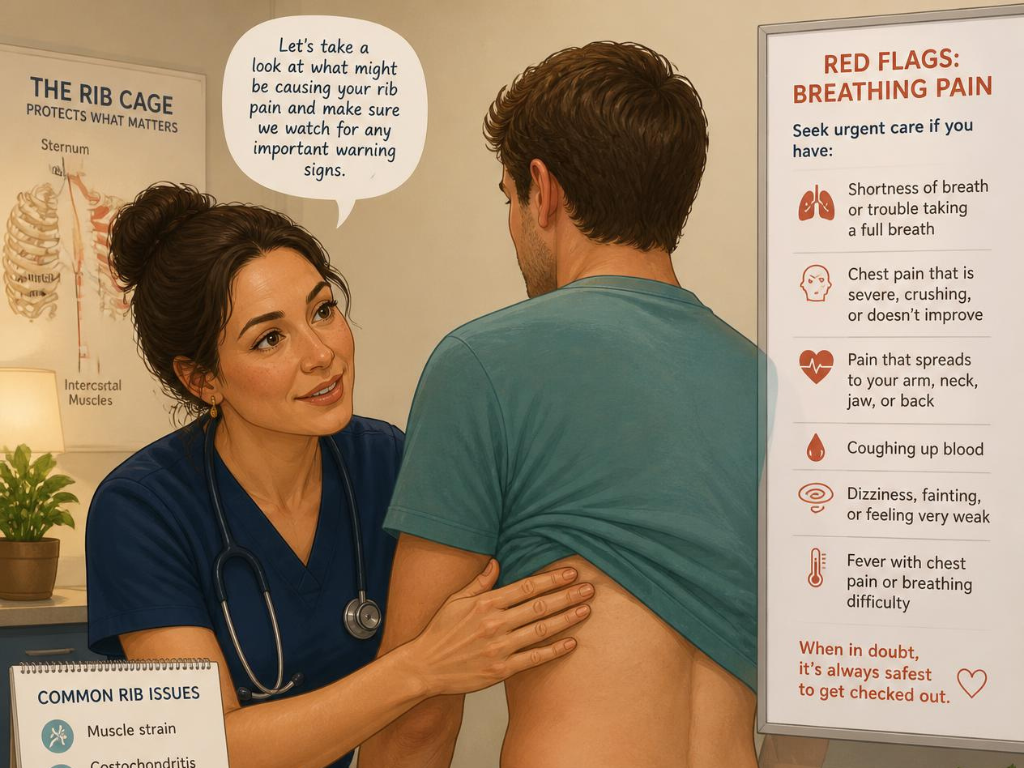
Certain features turn breathing-related pain into an emergency, and they override everything else. Pain that arrives suddenly and severely, comes with breathlessness, a fast or irregular heartbeat, coughing up blood, a painful swollen calf, faintness, or blue lips points to a pulmonary embolism, a clot in the lung, and demands immediate care. Pain with fever above 38 degrees Celsius, a productive cough, and fatigue suggests pneumonia. Sudden one-sided chest pain with shortness of breath can mean a pneumothorax, a collapsed lung.
These are not rare footnotes. Pleuritic pain, meaning pain worsened by breathing, has a serious differential that clinicians must exclude first, and a 2024 clinical review of pleurisy names pulmonary embolism as the most frequent severe cause, alongside myocardial infarction, aortic dissection, pneumonia, and pericarditis. The family medicine literature is blunt about the scale of it: reviewing the differential, Reamy and colleagues note that pulmonary embolism is “the most common serious cause” of pleuritic chest pain, found in 5% to 21% of emergency department presentations. If your breathing-related back pain carries any of these red flags, do not book a chiropractor. Call 995 or go to the nearest A&E. A crushing central chest pain, or a sudden tearing pain between the shoulder blades, is equally an emergency.
How can you tell mechanical rib pain from something serious?
The clearest test is reproducibility: mechanical pain can be triggered on demand by pressing or moving, while serious pain cannot. A costovertebral or intercostal problem reappears when you palpate the exact spot, rotate your trunk, or load the rib, and it settles when you hold still. Serious cardiopulmonary causes do not obey touch or posture; you cannot press a pulmonary embolism into flaring or ease it by changing position.
The company the pain keeps matters just as much. Mechanical rib pain travels alone, with no fever, no breathlessness at rest, no cough with blood, no swollen leg, and no faintness. Serious causes bring passengers. As one osteopathic review of chest pain puts it, “palpating the costovertebral junction often reproduces the pain,” which is exactly the sign a clinician looks for to confirm a musculoskeletal source. Worth noting: this test is a guide, not a guarantee. When mechanical features and red flags appear together, the red flags win, and medical assessment comes first. A responsible clinic runs this screen at the door, before any treatment decision, which is the whole point of proper triage.
How is mechanical rib and thoracic pain treated?
Mechanical rib pain responds well to restoring movement at the stiff joint. The core treatment is mobilising or adjusting the restricted costovertebral and costotransverse segments so the rib can pivot normally again during breathing. A well-targeted chiropractic adjustment frees the segment, and many people feel the catch on inspiration ease within one or two sessions once the joint moves cleanly.
Soft tissue work completes the picture. Releasing the intercostals and the paraspinal muscles that guard around an irritated rib joint reduces the spasm-pain cycle that keeps the area locked, which is where soft tissue therapy and breathing retraining earn their place. Posture correction addresses the desk-based loading that caused the dysfunction, and gentle thoracic mobility exercises stop it recurring. Most uncomplicated costovertebral cases settle within a handful of sessions, following the same sensible signs and recovery timelines as other joint dysfunctions. Routine imaging is not needed for straightforward rib joint pain; it is reserved for cases with red flags or a history of trauma.
Should you see a chiropractor or a doctor for back pain when breathing?
See a doctor or A&E first if any red flag is present; see a chiropractor when the pain is clearly mechanical. This is a question of scope of practice, and an honest clinic is explicit about it. Chiropractors are trained to treat costovertebral and thoracic joint dysfunction, and to screen for the serious causes they do not treat. If the screen turns up breathlessness, fever, cardiac features, or clot risk, the correct action is referral, not adjustment.
The decision is rarely ambiguous once you apply the reproducibility test and check for systemic signs. Pain you can recreate by pressing on a rib, with no fever and no breathlessness, belongs in a chiropractor’s chair. Pain that ignores touch and arrives with any red flag belongs in an emergency department. Where this breaks down is when people delay, telling themselves a frightening symptom is “just a muscle” to avoid a hospital trip. The safer habit is the reverse: treat sudden, severe, or red-flag breathing pain as serious until a doctor clears it, then let a chiropractor handle what is left. Good triage protects you in both directions.
Conclusion
Back pain that worsens when you breathe is usually a stiff costovertebral joint, sharp, one-sided, and reproducible by pressing or twisting. The same symptom occasionally signals a pulmonary embolism, pneumonia, or a cardiac problem, which is why the reproducibility test and a red-flag check come before any treatment. Pain you can recreate by touch, with no systemic signs, is a rib problem. Pain that ignores touch and brings breathlessness or fever is an emergency.
If your breathing-related back pain is mechanical and has no red flags, book a rib and thoracic assessment at Chirotherapy’s Orchard or Bugis clinic. You will get a full screen, a clear diagnosis, and targeted treatment to free the restricted joint. Book an assessment.
Frequently asked questions
Can a pulled muscle cause pain when breathing?
Yes. A strained intercostal muscle between the ribs commonly causes sharp pain that worsens on a deep breath, cough, or twist, often after heavy coughing, rowing, or an awkward movement. It is reproducible by pressing the area and carries no fever or breathlessness. This mechanical pain differs sharply from pleuritic pain caused by lung problems.
Is back pain when breathing a sign of a blood clot?
It can be. A pulmonary embolism causes sudden pleuritic pain and is the most common serious cause of it, found in 5% to 21% of emergency pleuritic pain cases. The warning signs are breathlessness, a fast heartbeat, coughing blood, or a painful swollen calf. If those appear, call 995 immediately rather than waiting.
Why does it hurt to breathe on one side of my back?
One-sided pain on breathing usually points to a single costovertebral joint or an intercostal muscle on that side, since rib dysfunction is typically unilateral and level-specific. Pleurisy also causes one-sided pain but adds a dry cough and often breathlessness. If the pain is purely reproducible by movement and touch, a rib joint is the likely source.
Can a chiropractor fix rib pain when breathing?
Yes, when the cause is a mechanical costovertebral or costotransverse joint restriction. Chirotherapy treats this by mobilising the stiff segment so the rib moves normally again, usually within a handful of sessions. The clinic first screens for red flags such as breathlessness or fever, and refers to a doctor when the pain is not musculoskeletal.
