 +65 6873 0809
 info@chirotherapy.com.sg
Blog
Scoliosis Chiropractor Singapore: What They Treat
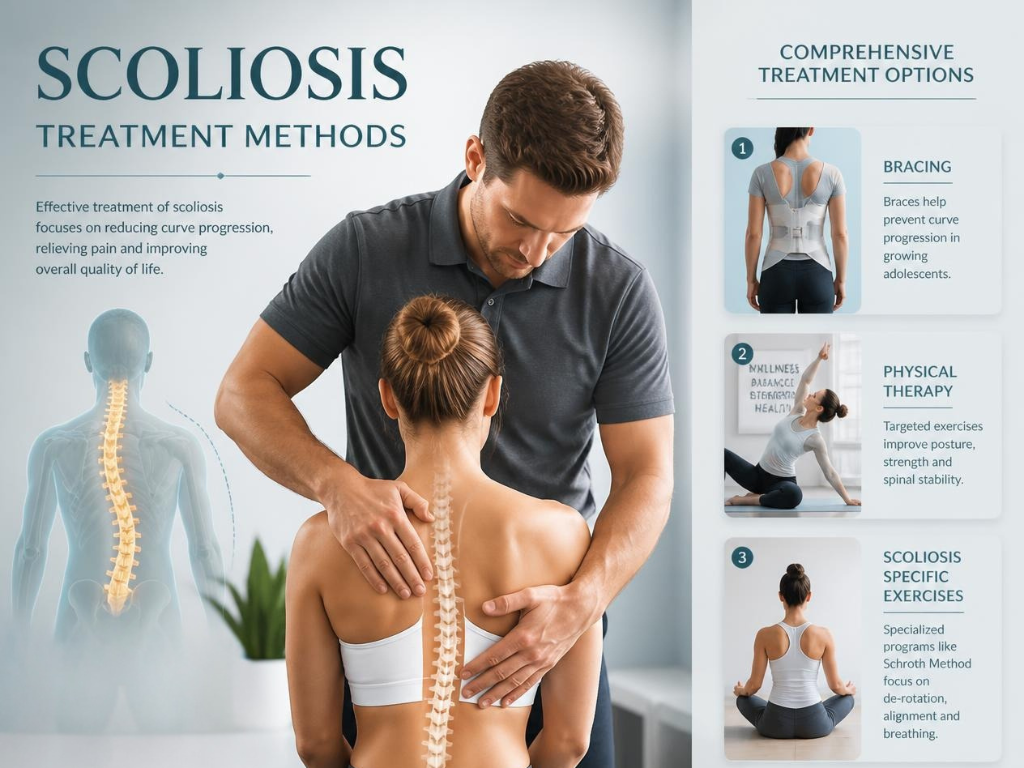
Sep
A scoliosis chiropractor in Singapore is often the first person a worried parent or an aching adult calls. Scoliosis affects around 2 to 3% of adolescents, and the honest scope of that first visit is narrower than most people expect. Chiropractic helps with what the curve does to you. It changes nothing about the curve itself. Knowing where that line sits decides whether a child gets the right treatment inside their growth window, and it shapes how chiropractic care in Singapore should be delivered for these cases.
What does a scoliosis chiropractor in Singapore actually treat?
A scoliosis chiropractor treats what the curve does to you: the muscle tension, the joint stiffness and the back pain, along with how comfortably you move. No chiropractic adjustment straightens a spine or reduces a Cobb angle. The role is symptom management, screening and referral.
That distinction matters because scoliosis is structural. The spine holds a fixed sideways curve with vertebral rotation, defined as a Cobb angle of 10 degrees or more on a standing X-ray, and anything below 10 degrees is normal spinal asymmetry rather than scoliosis. Chiropractic care makes an adult with an established curve more comfortable and more mobile, and it reduces the secondary muscle overload a curve creates. The bony deformity stays as it is. For a suspected new case, the most useful thing your chiropractor does happens before any treatment starts: recognising the curve, measuring the rotation, and sending you to the right specialist while a growing child still has growth left to protect. That screening role sits inside paediatric chiropractic care, where catching a curve early carries the most weight.
Can chiropractic straighten or fix scoliosis?
No. Chiropractic adjustment does not straighten a scoliosis curve or reduce the Cobb angle, and any clinic claiming otherwise is misrepresenting the evidence. Believing a curve can be adjusted away costs a family the months when bracing would have held it.
Bracing holds a curve while a child grows. Scoliosis-specific exercises slow progression. Surgery corrects severe curves. Adjustment does none of that, because a curved spine responds to sustained load and to growth, while a manual thrust lasts a fraction of a second. Marketing blurs the two by letting symptomatic relief imply correction. Feeling looser after an adjustment is real and worth having, and the X-ray reads the same afterwards. So we treat the pain honestly and refer the structure onward: chiropractic adjustment for comfort, a scoliosis specialist for the curve.
How is scoliosis measured and screened in Singapore?
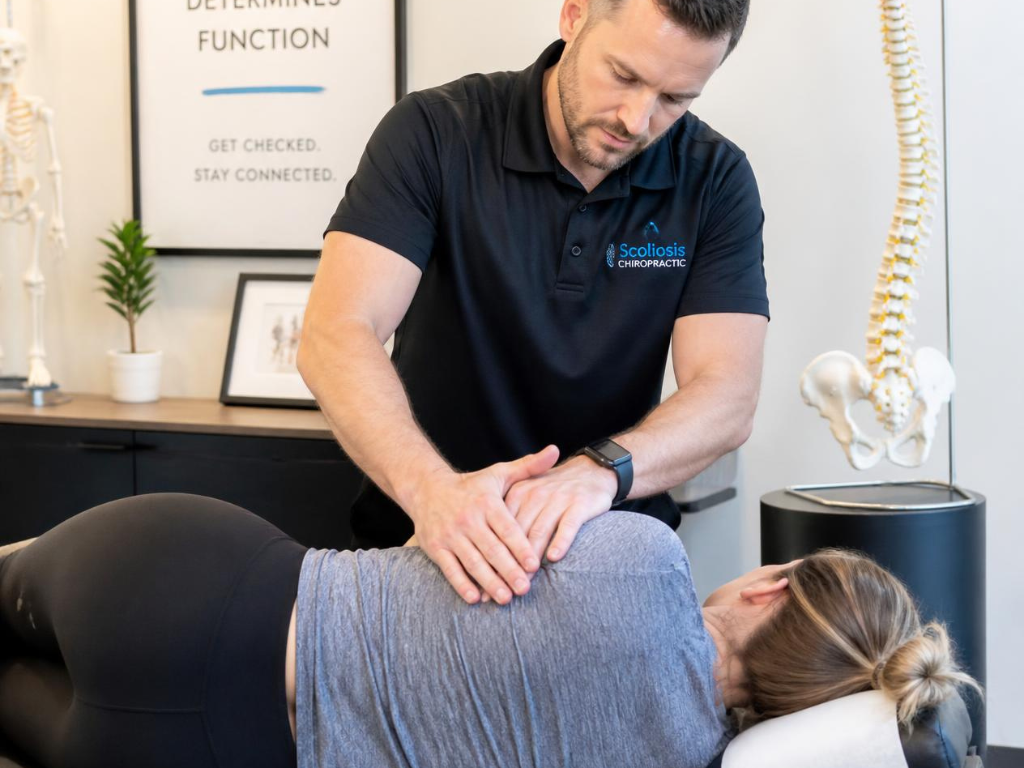
Clinicians screen scoliosis with a physical test and confirm it with an X-ray. The first-line tool is the Adam’s forward bend test. You bend forward, the clinician looks for a rib hump, and a scoliometer measures the angle of trunk rotation. Anything at 5 degrees or more goes for imaging.
Singapore has run school-based scoliosis screening for decades. The programme measures trunk rotation with a scoliometer in schoolchildren, refers those at or above 5 degrees to a Student Health Centre, then sends them for a posteroanterior spinal radiograph if the rotation persists. A Singapore screening study of 93,626 female students found prevalence rising with age, from 0.27% at age 9 to 2.49% at age 13, which is why the screening years cluster around the pubertal growth spurt. On the X-ray, the radiologist measures the Cobb angle between the most tilted vertebrae and grades skeletal maturity with the Risser sign, which estimates how much growth, and therefore how much progression risk, remains. Everything that happens next follows from that number, whether it reads 12 or 51.
When does scoliosis need an orthopaedic referral?
Any adolescent with a confirmed curve and remaining growth needs an orthopaedic referral, and so does any curve that is progressing or causing neurological symptoms. Growth drives progression, so 25 degrees in an 11-year-old is far more urgent than 25 degrees in a finished adult. The Cobb angle then sets the pathway. Specialists observe curves under 20 degrees, observe or brace 20 to 25 degrees, brace 26 to 45 degrees, and move toward surgery above 50, following SOSORT-aligned management thresholds.
Some features demand referral regardless of the angle. Rapid progression between visits, pain that is severe or wakes a child at night, leg weakness, numbness, or changes in bladder or bowel function all point to something beyond a routine idiopathic curve and need medical assessment first. Congenital or early-onset scoliosis in a young child is an orthopaedic matter from the outset. Girls carry the higher progression risk: a US screening review found that girls are “10 times more likely than males to have progression” of a curve to 30 degrees or more. Your chiropractor should screen for all of this and refer, rather than managing a growing curve in-house. Referring a case on is the correct clinical decision, and the one we make whenever there is growth still on the table.
What treatments actually change a scoliosis curve?
Bracing, scoliosis-specific exercises and surgery are the three treatments with evidence to alter or halt a curve. Bracing is the mainstay for growing children with moderate curves. It holds the curve where it is instead of straightening it, and the 2013 BRAIST trial showed bracing kept 72% of high-risk curves from reaching the surgical threshold, against 48% with observation alone.
Physiotherapeutic scoliosis-specific exercises, including the Schroth method, are the exercise approach with curve-level evidence, and specially trained physiotherapists deliver them rather than any general adjustment. A 2025 review noted that therapeutic exercises for AIS can “reduce spinal curvature, delay progression,” particularly in mild curves during growth. Surgeons reserve fusion for severe curves, usually above 45 to 50 degrees, where the deformity would otherwise worsen into adulthood. None of the three is chiropractic adjustment. The curve belongs with the orthopaedic surgeon, the scoliosis physiotherapist and the orthotist, while your chiropractor handles the comfort side, and knowing which one you need at which point is what stops a young spine losing ground.
Can chiropractic help adults with scoliosis and back pain?
Yes. For adults with an established curve, chiropractic offers real symptomatic relief, and that is where it belongs. Adult scoliosis, whether a curve carried since adolescence or a degenerative one that developed later, produces muscle fatigue, stiffness and back pain from the uneven load the curve places on the spine. Easing that load sits well within scope.
We work on function instead of the curve. Gentle mobilisation frees the stiff segments, soft tissue therapy releases the overworked muscles on the convex side, and strengthening targets the load pattern the curve creates. It is the same approach we use for mechanical back pain from any other cause, applied to a spine that happens to be curved. Where a curve is large or bone density is a concern, your chiropractor drops the aggressive techniques and works gently. What we can promise an adult with scoliosis is less pain and easier movement, with an X-ray that looks the same as it did before. For most adults who walk in, less pain is what they came for.
Conclusion
A scoliosis chiropractor in Singapore has a clear and limited role: easing the pain, stiffness and muscle overload a curve causes, and screening cases so they reach the right specialist. Chiropractic does not straighten a curve or reduce a Cobb angle. Bracing, scoliosis-specific exercises and surgery are what change a curve, and a growing adolescent curve belongs with an orthopaedic team. Ask any clinic which of those it provides, and where it refers you when the answer is none of them.
If you have a scoliosis diagnosis or a suspected curve, book an assessment at Chirotherapy’s Orchard or Bugis clinic. You will get an honest screen, symptom-focused care where that fits, and a prompt referral to an orthopaedic specialist when the curve needs one. Book a scoliosis assessment.
Frequently asked questions
Can scoliosis be treated without surgery in Singapore?
Yes, for most curves. Orthopaedic and physiotherapy specialists manage curves under about 45 degrees without surgery, using observation, bracing and scoliosis-specific exercises such as the Schroth method. The 2013 BRAIST trial showed bracing prevented surgery in 72% of high-risk cases. Chiropractic supports comfort alongside that, and does not replace specialist curve management.
Is chiropractic safe for scoliosis?
Chiropractic is safe for scoliosis when it targets symptoms with gentle, appropriate techniques rather than trying to force the curve straight. A qualified chiropractor at Chirotherapy screens the curve, adapts treatment to its severity, and avoids aggressive manipulation where a large curve or low bone density is present. Any child with a growing curve should be co-managed with an orthopaedic specialist.
At what Cobb angle do you need surgery for scoliosis?
Surgeons generally start discussing it once a curve reaches about 45 to 50 degrees, especially with growth remaining, because curves above 50 degrees tend to progress into adulthood. Timing depends on growth, progression rate and symptoms as much as on the angle. A growing child with a curve between 26 and 45 degrees is usually braced first to avoid reaching that threshold.
Does scoliosis get worse with age?
It can. In children, curves progress most during the pubertal growth spurt, which is why screening targets ages 9 to 13. In adults, larger curves above 50 degrees and degenerative change can worsen a curve slowly over decades. A curve that stayed stable through adulthood may still start causing more back pain, and that is where symptomatic chiropractic care earns its place.
