 +65 6873 0809
 info@chirotherapy.com.sg
Blog
Forward Head Posture: Muscular or Structural?
Sep
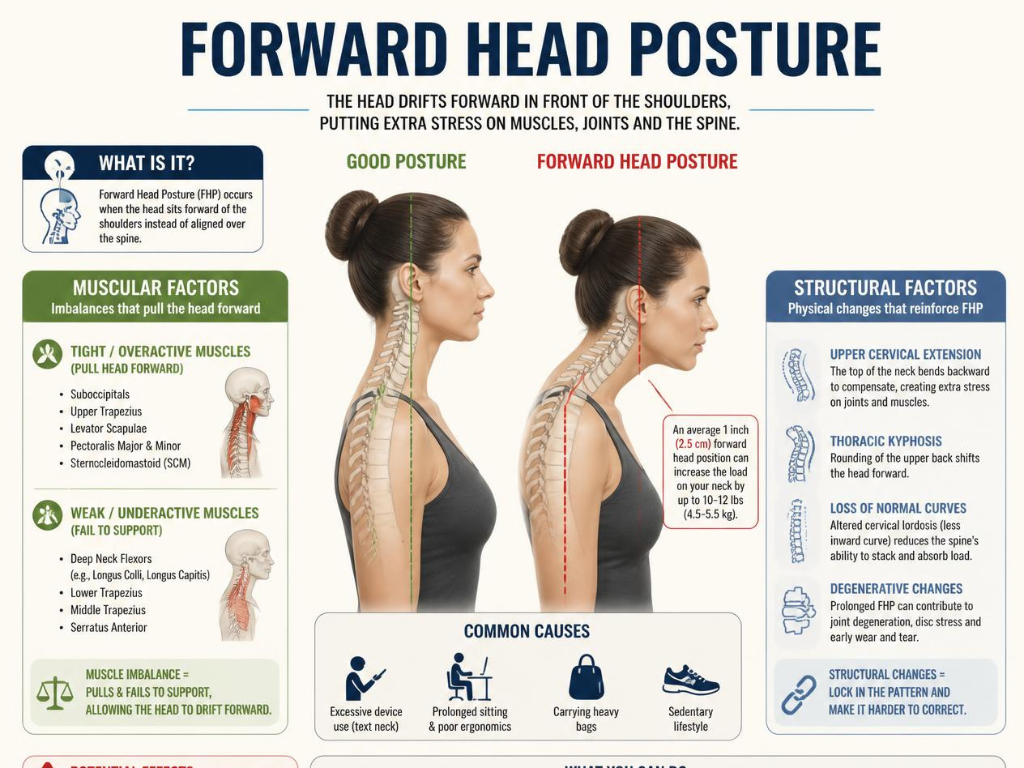
Forward head posture is the thing you spot in a side-profile photo someone else took, and want gone by next week. It shows up in more than 70% of office workers and heavy screen users. Before you start correcting it, work out whether yours is muscular or structural, because one responds to training and the other sets a ceiling on how far you get. That single question shapes the whole plan, including the chiropractic care at Chirotherapy built around it.
What is forward head posture, and how is it measured?
Forward head posture is a position where the head sits ahead of the shoulders rather than balanced over them, measured by the craniovertebral angle. A craniovertebral angle below 48 to 50 degrees, taken from a side photo as the angle between the C7 vertebra and the ear tragus, indicates forward head posture. Above 50 degrees counts as a normal head position.
The craniovertebral angle turns a subjective look into a number you can track. Your clinician marks the tip of the C7 spinous process and the tragus of the ear, then measures the angle that line makes with the horizontal. A smaller angle means the head has drifted further forward. A 2025 systematic review found that forward head posture occurs in “more than 70% of office workers, students, and high screen time people.” Most of those cases are muscular and correctable. A minority are structural and are not, and no exercise plan is worth starting until you know which group you fall into.
How can you tell if your forward head posture is muscular or structural?
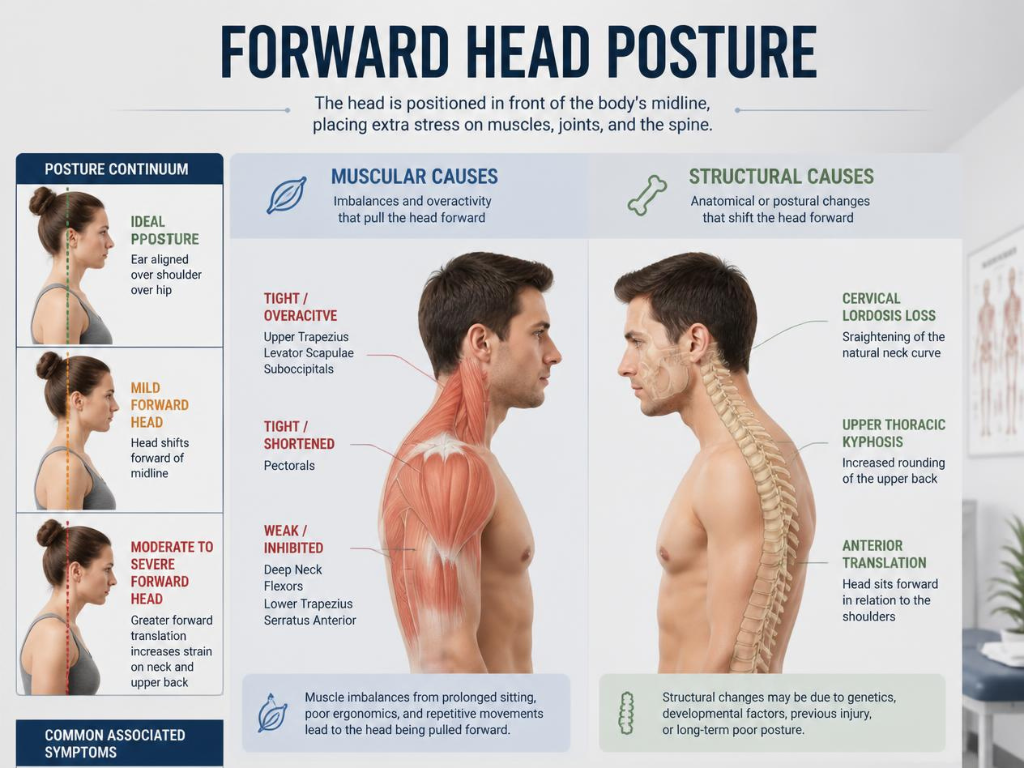
Muscular forward head posture corrects when you straighten up or lie down. Structural posture stays put. If you can tuck your chin, lengthen the back of your neck and bring your head back over your shoulders, the restriction is soft tissue and habit, which is the correctable kind. If your head will not come back however hard you try, the limit sits in the bones and joints.
Two checks separate them. Sit tall and do a gentle chin tuck: a muscular pattern improves as you watch, a structural one hardly moves. Then lie flat on your back without a pillow. If your head rests down without effort, the posture is functional and load-dependent. If it hangs forward and cannot reach the surface, a fixed thoracic curve is holding it there. Structural forward head posture usually rides on a rigid thoracic kyphosis, from conditions like Scheuermann’s disease or age-related vertebral change, and the mid-back will not extend when you reach overhead. Most people have some of both. A mostly muscular posture can sit on a stiff thorax, so ask how much of it corrects on movement rather than sorting yourself into one box, because whatever corrects is the part that will respond to training.
How do you check your forward head posture at home?
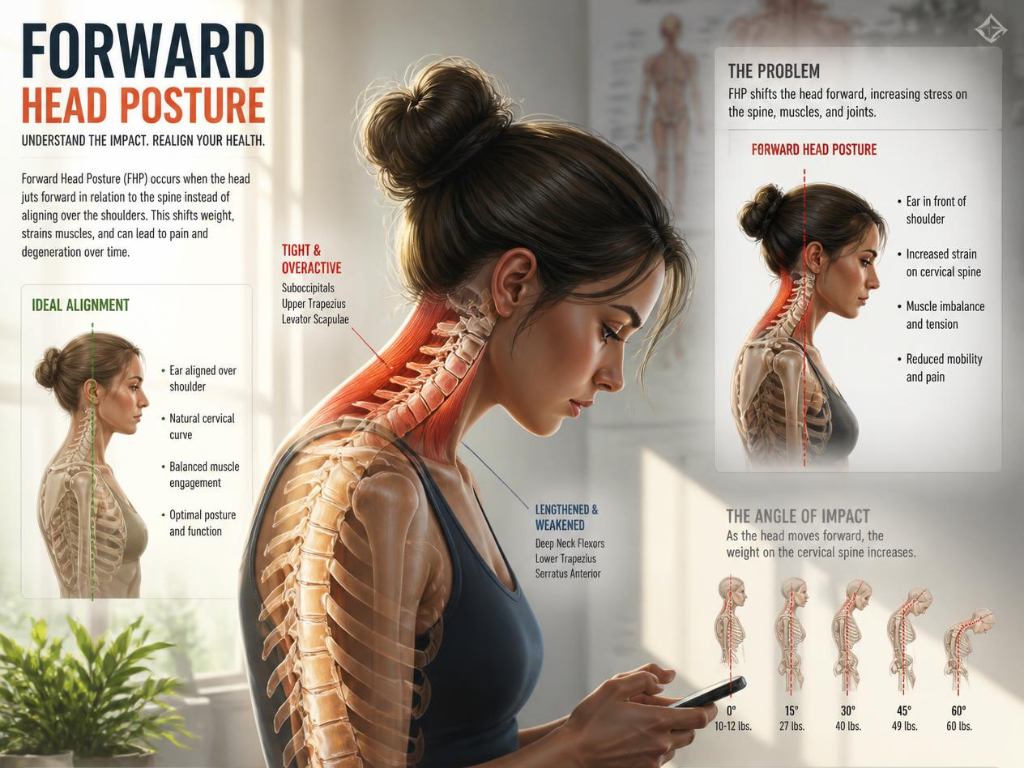
Take a relaxed side-profile photo and look at where your ear sits relative to your shoulder. Stand against a plain background, look straight ahead, and have someone photograph you from the side. In a neutral head position the ear canal lines up roughly over the middle of the shoulder. In forward head posture the ear sits in front of it, and the further forward it sits, the lower your craniovertebral angle.
The wall test gives you a second reading. Stand with your heels, buttocks and upper back against a wall, then let your head fall back. If the back of your head touches the wall without you forcing it, your resting posture is close to neutral. If a gap remains and you have to strain to close it, your head carries forward at rest. Repeat the photo every four to six weeks once you start corrective work, because craniovertebral angle change shows up over that window and you will not accurately remember what your neck looked like two months ago. Your clinician tracks it the same way when assessing desk-related neck strain, which turns a vague complaint about bad posture into a number you can follow.
What causes forward head posture?
Sustained screen use is the leading cause, through a predictable chain of muscle changes. Hours spent looking down at a phone or forward at a low monitor weaken and lengthen the deep neck flexors, the small muscles that hold the head back, while the upper trapezius and levator scapulae shorten and overwork to carry the load. The suboccipital muscles at the base of the skull tighten into that familiar band of tension. A 2025 review using ultrasound confirmed measurable changes in deep neck flexor and other neck muscle sizes in people with forward head posture compared to those without.
The mid-back plays a bigger role than most people expect. A stiff, flexed thoracic spine pushes the whole chain forward, so the head drifts to keep the eyes level, which is why thoracic mobility matters as much as neck strengthening. Screen height is the easiest thing on this list to fix. A monitor below eye level, or a phone held at waist height, forces the exact position that trains the posture in. Raise the screen and you remove the daily driver. Soft tissue therapy on the upper trapezius and suboccipitals handles the tension that builds along the way. This desk-driven pattern is what people call text neck, and across Singapore’s screen-heavy offices it is close to universal.
What causes a neck hump, and when is it more than posture?
A neck hump has three common causes, and one of them belongs in a doctor’s office rather than a posture routine. The most common is postural: soft tissue thickening over a rounded cervicothoracic junction from long-term forward head posture, which is benign and partly correctable. The second is a dowager’s hump, a fixed bony kyphosis often caused by osteoporotic vertebral compression fractures in older adults. The third is a buffalo hump, a soft fat pad that feels denser than ordinary fat.
The buffalo hump is the one to take seriously. A buffalo hump is a dorsocervical fat pad whose leading cause is excess cortisol, known as Cushing syndrome, with links to long-term corticosteroid use, certain medications and metabolic conditions. See a doctor rather than a posture coach if a neck hump appears quickly, feels firm and fatty rather than bony, or arrives alongside weight gain, a rounded face, easy bruising, or a history of steroid use. An older adult with a new or worsening bony hump needs a bone health assessment, since a dowager’s hump can signal osteoporosis. Posture work helps the postural version and does nothing for a fat pad driven by a hormone problem, so identify which hump you have before you treat it.
Can forward head posture be fixed?
You can fix the muscular version. The structural component will not reverse, though function improves around it. The correctable version responds to a specific combination: strengthening the deep neck flexors, mobilising the stiff thoracic spine, releasing the overactive upper trapezius and suboccipitals, and raising your screen. Deep cervical flexor training increases the craniovertebral angle, with measurable change over 4 to 8 weeks of consistent work.
Two things to expect. A fixed thoracic curve or established vertebral change does not reverse with exercise at any age, though training the muscle and habit around it still buys you comfort and control. And correcting the angle will not reliably fix your neck pain, because the link between the two is inconsistent: one 2024 study of IT professionals found “no significant association of CVA with non-specific neck pain.” Correct it for function and for how you carry yourself, and treat any pain relief as a bonus rather than the plan. A chiropractic adjustment frees the stiff segments so the corrected position is reachable, and the strengthening is what makes it stay. Gadgets and braces skip the training that moves the craniovertebral angle, which is why they leave the number exactly where they found it.
Conclusion
In most people forward head posture is muscular. The head drifts forward on weak deep neck flexors, tight upper traps and a stiff mid-back, and all three respond to training over a couple of months. The structural version rides on a fixed thoracic curve and does not reverse, though function improves around it. The chin tuck and the lying-down test will tell you which one you are dealing with in under two minutes. A firm or fast-growing neck hump is a different matter and belongs with a doctor.
If you want to know whether your forward head posture is correctable, book an assessment at Chirotherapy’s Orchard or Bugis clinic. You will get a craniovertebral angle measurement, a clear muscular-versus-structural verdict, and a plan built around what can change. Book a posture assessment.
Frequently asked questions
Does forward head posture cause headaches?
It can contribute. Forward head posture loads the suboccipital muscles and upper cervical joints, and those are a common source of cervicogenic headaches that start at the base of the skull. The link does not hold for everyone, so get headaches assessed properly instead of blaming your posture for them. At Chirotherapy we treat the upper neck joints and muscles together where that pattern is present.
Is text neck permanent?
No, in most cases. Text neck is muscular forward head posture driven by screen habits, and it responds to deep neck flexor strengthening and screen changes over 4 to 8 weeks. It becomes harder to reverse only once a fixed thoracic kyphosis has developed underneath it. Raising your screen to eye level removes the daily cause and remains the single most effective step you can take.
When should I see a doctor about a neck hump?
See a doctor if a neck hump appears quickly, feels soft and fatty rather than bony, or comes with weight gain, a rounded face, easy bruising, or long-term steroid use, since a buffalo hump can signal Cushing syndrome. Older adults with a new bony hump need a bone health check, because a dowager’s hump can indicate osteoporosis. Most neck humps turn out to be postural, and the ones that are not are the reason to get it looked at.
Can a chiropractor fix forward head posture?
A chiropractor can correct the muscular component and screen for the structural one. Treatment combines adjustment to mobilise the stiff thoracic and cervical segments, soft tissue work on the upper trapezius and suboccipitals, and a deep neck flexor strengthening plan. At Chirotherapy we measure the craniovertebral angle first, so you know whether your posture is correctable before you commit to anything.
